Aspergillus (Eurotium): Structure, Reproduction, Life Cycle & Economic Importance | BSc Botany Notes
Complete BSc Botany study note on Aspergillus (Eurotium) covering general features, systematic position, somatic structure, asexual and sexual reproduction, cleistothecium formation, ascus, ascospores, life cycle (haplophase, dikaryophase, diplophase), and economic importance for university examinations.
Aspergillus (Eurotium): General Features, Structure, Reproduction, Life Cycle and Economic Importance
Aspergillus (Eurotium) is one of the most extensively studied genera of filamentous fungi taught in BSc Botany and Mycology courses. It is a large, cosmopolitan genus of the phylum Ascomycota, well known for its characteristic asexual conidial heads and, in many species, for a sexual stage that classical mycology textbooks describe under the name Eurotium. Because Aspergillus combines a simple vegetative structure with a biologically informative sexual cycle and enormous economic significance — both beneficial and harmful — it is a favourite topic for 10–15 mark long-answer questions in university examinations. This note presents a complete, examination-oriented account of Aspergillus (Eurotium), covering its general features, systematic position, habit and habitat, somatic structure, vegetative, asexual and sexual reproduction, life cycle, and economic importance.
Before proceeding, one taxonomic clarification is essential for students. Aspergillus and Eurotium are not two different organisms. In older dual (form-genus) nomenclature, fungi that reproduce both asexually and sexually were often given two separate scientific names: one for the asexual (conidial/anamorphic) stage and one for the sexual (ascosporic/teleomorphic) stage. For a number of Aspergillus species that possess a sexual stage, this sexual stage was traditionally named Eurotium. Thus, "Aspergillus" refers to the asexual, conidia-producing phase of the fungus, while "Eurotium" refers to the sexual, ascospore-producing phase of the very same organism. Since 2011, the International Code of Nomenclature adopted a "one fungus, one name" principle, and modern taxonomic revisions (based on molecular phylogeny) have placed Eurotium species within the genus Aspergillus itself. However, because BSc syllabi and standard textbooks continue to use the traditional dual terminology to explain the relationship between the asexual and sexual phases, this note retains the conventional name Aspergillus (Eurotium) throughout, while noting the modern position where relevant.
General Features of Aspergillus
The genus Aspergillus was established by the Italian botanist Pier Antonio Micheli in 1729. He observed that the spore-bearing head of the fungus, with spore chains radiating from a central swollen tip, resembled an aspergillum, the brush-like device used to sprinkle holy water — and named the genus accordingly. This etymological detail is a useful point to remember for examinations, as it directly explains the distinctive branching pattern described later in this note.
Aspergillus is a filamentous, eukaryotic, achlorophyllous (non-green) fungus belonging to the Ascomycota. It shows the following general fungal characteristics relevant to Aspergillus general features:
- Thallus organisation: The plant body (thallus) is mycelial, consisting of a mass of thread-like, branched filaments called hyphae. It is never unicellular or plasmodial.
- Mode of nutrition: Aspergillus is heterotrophic and obtains nutrition by absorption. Most species are saprophytic, deriving nutrients from dead and decaying organic matter; a few species behave as weak or opportunistic parasites on plants, stored products, and occasionally on animals and humans.
- Hyphal organisation and septation: The mycelium is septate, i.e., cross-walls (septa) divide the hyphae into cell-like compartments. Each septum typically has a small central pore that allows cytoplasmic and, to some extent, nuclear continuity between adjacent cells.
- Branching: The hyphae are profusely and irregularly branched, giving the mycelium a cottony or velvety texture in culture.
- Cell wall: The hyphal wall is composed mainly of chitin and glucan, typical of true fungi (Eumycota), and is rigid, giving mechanical support to the thallus.
- Nuclear condition: The vegetative hyphal cells are typically multinucleate (coenocytic within each compartment) and haploid; the haploid condition dominates the vegetative phase of the life cycle.
- Reproductive methods: Aspergillus reproduces by three methods — vegetative (fragmentation), asexual (conidia), and, in species possessing the Eurotium stage, sexual (ascospores formed within a cleistothecium).
- Colony character: Colonies are typically fast-growing, powdery or granular, and variously pigmented (green, black, yellow, brown, or white) due to the colour of the conidia, which is an important field/laboratory identification feature.
Aspergillus is considered one of the most important genera in mycology because of its extremely wide distribution, its simple but highly efficient method of asexual spore production, its well-studied sexual cycle in the Eurotium-forming species, and its immense economic significance in industry, agriculture, food science, and medicine, discussed later under Economic Importance.
Systematic Position of Aspergillus
The Aspergillus systematic position is generally presented in BSc textbooks using the traditional Ascomycete classification scheme. Modern molecular studies have refined family-level placement, and both are indicated below.
| Taxonomic Rank | Traditional / Textbook Classification | Modern Note |
|---|---|---|
| Kingdom | Fungi | Unchanged |
| Division / Phylum | Ascomycota (Eumycota — Ascomycotina) | Unchanged |
| Class | Ascomycetes (Euascomycetes / Plectomycetes) | Eurotiomycetes in modern molecular classification |
| Order | Eurotiales (older texts: Plectascales) | Eurotiales retained |
| Family | Trichocomaceae (older texts: Aspergillaceae / Eurotiaceae) | Family Aspergillaceae, based on recent phylogenetic revision |
| Genus (asexual/anamorphic name) | Aspergillus Micheli ex Fr. | Retained as the single accepted genus name |
| Genus (sexual/teleomorphic name, traditional) | Eurotium Link | Now treated as a synonym / section within Aspergillus |
| Representative species | Aspergillus niger, A. flavus, A. fumigatus, A. oryzae, A. terreus | — |
Students should note that prior to 2011, fungal nomenclature permitted a single organism to carry two valid Latin binomials — one for its asexual (anamorphic) phase and one for its sexual (teleomorphic) phase. Under this "dual nomenclature" system, several homothallic Aspergillus species (those that could complete a sexual cycle) were classified under the separate genus Eurotium when their cleistothecial (sexual) stage was being described. Following the "one fungus, one name" reform adopted in the modern International Code of Nomenclature for algae, fungi, and plants, this dual system was abolished, and Eurotium was formally merged into Aspergillus. BSc syllabi, however, continue to teach the sexual cycle under the traditional heading "Aspergillus (Eurotium)" because it clearly separates the discussion of the asexual (Aspergillus) and sexual (Eurotium) phases for examination purposes.
Habit and Habitat of Aspergillus
Aspergillus shows a saprophytic mode of life and is one of the most widely distributed fungi on Earth, a fact directly relevant to the query Aspergillus habit and habitat. It grows on almost any organic substrate provided moisture and suitable temperature are available.
- Soil: Aspergillus is a common soil-inhabiting fungus, where it participates actively in the decomposition of plant litter and organic debris.
- Decaying organic matter: It readily colonises dead leaves, twigs, dung, compost, and other decomposing plant and animal material.
- Food materials: It is frequently found growing on bread, jams, pickles, fruits, vegetables, cereals, pulses, nuts, spices, and other stored food products, often producing visible green, black, or yellow mould growth.
- Other substrates: Aspergillus also grows on leather, textiles, paper, damp walls, and other humid organic and semi-organic materials.
- Occasional parasitism: A small number of species behave as opportunistic pathogens of plants, stored grains, and animals, including humans, particularly when the host's natural defences are compromised (see Mycoses).
- Environmental requirements: Most species grow well over a wide temperature range (roughly 6°C to 50°C), with an optimum near 25–30°C; some species, such as Aspergillus fumigatus, are thermotolerant and can grow at temperatures as high as human body temperature. Many species are also xerophilic, i.e., able to grow at relatively low moisture (water activity) levels, which explains why Aspergillus commonly spoils dry stored grains that resist attack by less tolerant fungi.
- Distribution: Aspergillus has a cosmopolitan distribution, being especially abundant in warm, humid tropical and subtropical regions, though it is also found in temperate climates.
Because Aspergillus conidia are minute, abundantly produced, and easily airborne, the fungus is almost universally present in indoor and outdoor air, which explains why it is so commonly and rapidly encountered as a coloniser of exposed organic material.
Somatic Structure of Aspergillus
Mycelium
The vegetative body of Aspergillus, relevant to Aspergillus somatic structure, consists of a well-developed, branched, septate mycelium composed of individual filaments called hyphae. Each hypha is a tubular structure bounded by a rigid chitinous cell wall and lined internally by a thin layer of cytoplasm surrounding a large central vacuole. The hyphae are divided at intervals by cross septa into compartments, each containing one or more haploid nuclei; the septal pore permits limited cytoplasmic streaming between adjacent compartments. Hyphal growth occurs exclusively at the hyphal tip (apical growth), where new wall material is continuously synthesised and deposited, allowing the mycelium to spread rapidly over the substrate. The mycelium is colourless (hyaline) in the vegetative state but produces variously pigmented reproductive structures, which is why Aspergillus colonies show characteristic surface colours. Nutrition is absorptive: the hyphae secrete extracellular enzymes onto the substrate, digesting complex organic molecules externally, after which the simpler products are absorbed across the hyphal wall and plasma membrane.
Special Reproductive Structures
A small group of specialised somatic cells give rise to the characteristic asexual reproductive apparatus of Aspergillus, and their structure is frequently asked in examinations.
| Structure | Description | Function |
|---|---|---|
| Foot cell | A specialised, somewhat thick-walled cell of the vegetative hypha, often slightly enlarged and bent, from which the conidiophore arises, typically at a right angle, giving a foot-like appearance. | Anchors and gives rise to the conidiophore; marks the beginning of the asexual reproductive branch. |
| Conidiophore | A long, erect, unbranched, usually aseptate hyphal branch arising from the foot cell and terminating in a swollen apex. | Elevates the spore-bearing head above the substrate, aiding spore dispersal. |
| Vesicle | The swollen, spherical to club-shaped terminal enlargement of the conidiophore. | Provides the surface on which sterigmata (phialides) develop. |
| Sterigmata (Metulae and Phialides) | Flask-shaped cells covering the vesicle surface. In uniseriate species, a single row of sterigmata (phialides) arises directly from the vesicle. In biseriate species, primary sterigmata (metulae) arise from the vesicle, and secondary sterigmata (phialides) arise from the metulae. | Each phialide is the actual conidium-producing cell, cutting off conidia in basipetal succession. |
| Conidia | Small, single-celled, thin- to thick-walled, pigmented spores produced in unbranched basipetal chains from the tip of each phialide. | Asexual reproductive units; responsible for rapid dispersal and colonisation of new substrates. |
Reproduction in Aspergillus
Aspergillus reproduces by three principal methods, discussed below under Aspergillus reproduction: vegetative reproduction by fragmentation, asexual reproduction by conidia, and sexual reproduction by ascospores formed within a cleistothecium (the "Eurotium" stage).
A. Vegetative Reproduction — Fragmentation
Vegetative reproduction is the simplest method by which Aspergillus perpetuates itself without the formation of specialised spores. Under favourable conditions of moisture, nutrition, or mechanical disturbance, the mycelium may become accidentally broken into separate fragments. Each such fragment, provided it retains at least one viable nucleus and adequate cytoplasm, is capable of independent growth. Upon coming into contact with a suitable substrate, the hyphal fragment absorbs water and nutrients, resumes apical growth, and develops into a completely new, independent mycelium genetically identical to the parent. Fragmentation may occur naturally due to ageing and autolysis of older hyphal regions, or artificially through physical agitation of the culture, as is deliberately exploited during laboratory sub-culturing and industrial inoculum preparation. Although vegetative reproduction is not a major means of natural dispersal compared to conidial formation, it is biologically significant because it allows rapid multiplication of an already well-adapted mycelium without the time and energy cost of forming specialised reproductive structures.
B. Asexual Reproduction — Conidia Formation
Asexual reproduction is the principal and most conspicuous method of multiplication in Aspergillus, central to any discussion of Aspergillus conidia formation. It is exogenous (spores are cut off externally, not formed inside a sporangium), distinguishing Aspergillus from sporangial fungi such as Rhizopus and Mucor. The process occurs in the following sequence:
- Selection of the foot cell: A specific cell of the vegetative hypha becomes differentiated as the foot cell, distinguished by a slightly thickened wall.
- Emergence of the conidiophore: From the foot cell, a long, erect, aseptate hyphal branch — the conidiophore — grows out, usually at a right angle to the parent hypha, and elongates vertically away from the substrate.
- Formation of the terminal vesicle: The tip of the conidiophore stops elongating and swells to form a spherical, oval, or club-shaped structure called the vesicle.
- Formation of sterigmata (phialides): Over the entire surface, or over the upper two-thirds of the vesicle, a layer of small flask-shaped cells called sterigmata develops.
- Primary and secondary sterigmata: In biseriate species, the sterigmata that arise directly from the vesicle are called primary sterigmata or metulae; each metula in turn produces a whorl of smaller secondary sterigmata called phialides. In uniseriate species, phialides arise directly from the vesicle without an intervening row of metulae.
- Development of conidia: Each phialide functions as a conidiogenous cell. Repeated mitotic divisions at the tip of the phialide cut off uninucleate, spherical to subspherical conidia in immediate succession.
- Arrangement of conidia in chains: Because each new conidium is formed just outside the previously formed one (basipetal succession — the youngest spore lies closest to the phialide and the oldest at the free end), the conidia remain attached to one another, forming long, unbranched, dry chains radiating outward from the vesicle.
- Maturation of conidia: As the conidia mature, their walls thicken and become pigmented (green, black, yellow, or brown depending on the species), giving Aspergillus colonies their characteristic colour.
- Liberation and dispersal of conidia: The chains of conidia, being extremely light and produced in enormous numbers, readily separate at maturity and become airborne, being dispersed chiefly by wind, and secondarily by water, insects, and mechanical disturbance.
- Germination of conidia: Upon reaching a suitable moist substrate, each conidium absorbs water, its cytoplasm becomes active, and it puts out one or more germ tubes.
- Development of new mycelium: The germ tube elongates and branches repeatedly by apical growth to establish a new, independent haploid mycelium, completing the asexual cycle.
Biological significance: Conidial reproduction allows Aspergillus to multiply with extraordinary speed and in vast numbers, ensures wide aerial dispersal, and enables rapid colonisation of fresh substrate — features that explain both its ecological success as a decomposer and its importance as a common contaminant of stored food, industrial materials, and, occasionally, as an airborne pathogen.
Structure of a Typical Conidial Head
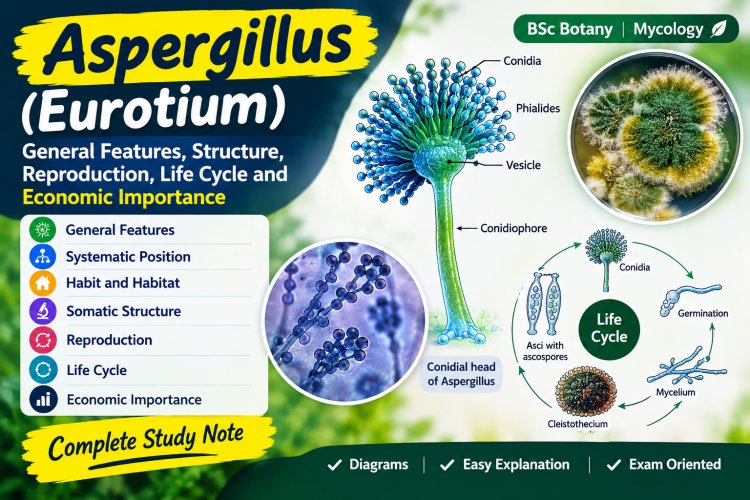
For examination purposes, students should be able to describe and draw the complete conidial head of Aspergillus, which consists of the following parts, arranged from base to apex:
- Foot cell — the specialised basal hyphal cell from which the conidiophore originates.
- Conidiophore — the long, erect, unbranched stalk bearing the entire fertile head at its tip.
- Vesicle — the swollen terminal portion of the conidiophore that bears the sterigmata.
- Sterigmata (metulae and/or phialides) — the flask-shaped conidiogenous cells covering the vesicle, arranged uniseriately (phialides alone) or biseriately (metulae bearing phialides).
- Conidia — the chains of pigmented, single-celled asexual spores borne on the phialides, radiating outward in all directions to give the whole structure its characteristic brush-like or "aspergillum-like" appearance.
This radiating arrangement of spore chains around a central axis is the single most important diagnostic feature separating Aspergillus from related genera such as Penicillium, in which the conidiophore branches repeatedly into a broom-like (penicillate) structure rather than terminating in a single swollen vesicle.
C. Sexual Reproduction
Sexual reproduction, discussed here under Aspergillus sexual reproduction, occurs only in those species of Aspergillus that possess the ability to complete the sexual (Eurotium) stage; many common species are known only in their asexual state. Most Eurotium-forming species are homothallic, meaning that both male and female sex organs are produced on the same haploid mycelium, so that self-fertilisation is possible without the need for two compatible mating strains.
Formation of Antheridium
The antheridium is the male sex organ. It develops as a short, club-shaped, multinucleate lateral branch from a vegetative hypha, situated close to the developing archicarp. Like the rest of the vegetative mycelium, its nuclei are haploid. The antheridium grows toward the coiled archicarp and comes into direct contact with it, or in some species with a receptive projection of the archicarp, at which point it functions purely as the donor of male nuclei and cytoplasm during fertilisation; it plays no further role after plasmogamy.
Formation of Archicarp
The archicarp is the female sex organ. It arises as a multicellular hyphal branch that grows and coils upon itself repeatedly, forming a characteristic helical structure. The terminal, coiled portion of the archicarp differentiates into the ascogonium, the region that will actually receive the male nuclei. In several Eurotium-forming species, the tip of the ascogonium may develop a short receptive outgrowth that establishes contact with the antheridium. The remaining basal cells of the archicarp later contribute sterile hyphae that help enclose the developing sexual structure. The antheridium and archicarp are thus intimately related — the archicarp represents the female partner that must receive nuclei donated by the antheridium before the sexual cycle can proceed to fertilisation.
Fertilization
Fertilisation in Aspergillus (Eurotium) takes place in the following sequence:
- The antheridium comes into close contact with the coiled ascogonial tip of the archicarp.
- The wall separating the two gametangia breaks down at the point of contact, establishing cytoplasmic continuity.
- The multiple haploid nuclei and cytoplasm of the antheridium migrate into the ascogonium. This transfer of cytoplasm and nuclei, without immediate nuclear fusion, constitutes plasmogamy.
- Inside the ascogonium, the migrated antheridial nuclei pair up with the resident ascogonial nuclei, but the two nuclei of each pair do not fuse immediately; instead they divide together in a coordinated manner. This produces a dikaryotic condition, in which each cell contains two genetically distinct haploid nuclei (commonly written N + N).
- From the fertilised ascogonium, dikaryotic ascogenous hyphae grow outward, their cells all containing paired (N + N) nuclei.
- Simultaneously, sterile hyphae from the surrounding haploid mycelium proliferate and interweave around the fertilised ascogonium and its ascogenous hyphae, forming the young ascocarp initial that will mature into the cleistothecium.
Students must clearly distinguish the two key nuclear events of the sexual cycle: plasmogamy (fusion of cytoplasm and coming together of two compatible nuclei to form the dikaryotic phase) is followed only much later, inside the young ascus, by karyogamy (actual fusion of the two nuclei to form a diploid nucleus). The dikaryotic phase intervenes between these two events and should never be confused with the diploid phase.
Cleistothecium / Ascocarp Formation
A cleistothecium is defined as a completely closed, spherical ascocarp (fruiting body) that lacks any special pore or opening (ostiole) for spore release. Its formation in Aspergillus (Eurotium) proceeds as follows:
- Following fertilisation, sterile hyphae arising from cells near the base of the archicarp grow rapidly and repeatedly branch, interweaving tightly around the fertilised ascogonium and the developing dikaryotic ascogenous hyphae.
- These sterile hyphae become closely packed and pseudoparenchymatous (tissue-like), forming a continuous protective covering called the peridium.
- As the structure enlarges, it becomes a spherical body, typically yellow in colour in most Eurotium-forming species, enclosing the fertile tissue completely on all sides.
- Inside this enclosed cavity, the dikaryotic ascogenous hyphae continue to grow and branch, their terminal cells eventually differentiating into numerous ascus mother cells.
- Each ascus mother cell develops into a mature ascus (described below), so that a single cleistothecium may ultimately contain hundreds to thousands of asci arranged irregularly within the central cavity.
- At maturity, the cleistothecium is a firm, closed, thick-walled body; because it possesses no ostiole, ascospores are released only when the peridium ruptures or decays, exposing the spore mass for dispersal by wind, water, or animal vectors.
The cleistothecium is called a closed fruiting body precisely because, unlike a perithecium (which has a pore-like ostiole) or an apothecium (which is open and cup-shaped from the start), it remains entirely enclosed by its peridial wall throughout development, and spores can only escape after the wall breaks down.
Ascus
The ascus is the characteristic sac-like, spore-producing cell of all Ascomycota, including Aspergillus (Eurotium), and its development proceeds as follows:
- An ascus mother cell differentiates at the tip of a dikaryotic ascogenous hyphal branch; it contains the paired (N + N) nuclei inherited from plasmogamy.
- The two haploid nuclei within the ascus mother cell fuse completely — this is karyogamy — producing a single diploid (2N) nucleus. This is the only diploid stage in the entire life cycle of Aspergillus.
- The diploid nucleus almost immediately undergoes meiosis (reduction division), producing four haploid nuclei.
- Each of these four haploid nuclei then undergoes one additional mitotic division, resulting in a total of eight haploid nuclei within the developing ascus.
- Wall material is deposited around each of the eight nuclei along with a portion of cytoplasm, delimiting eight individual ascospores inside the ascus.
- The mature ascus is typically small, spherical to broadly ellipsoidal, thin-walled, and unlike asci of many other Ascomycetes, it is evanescent — its wall breaks down or dissolves at maturity, releasing the eight ascospores freely within the cavity of the cleistothecium rather than through active discharge.
The complete nuclear sequence to remember for examinations is: Dikaryotic condition (N + N) → Karyogamy → Diploid nucleus (2N) → Meiosis → Four haploid nuclei → Mitosis → Eight haploid nuclei → Eight ascospores.
Ascospores
Ascospores are the sexually produced spores of Aspergillus (Eurotium), formed as described above, eight within each ascus. Their principal features are:
- Number: Typically eight per ascus, arranged irregularly (not in a fixed linear row) because the ascus wall dissolves early and does not constrain their arrangement.
- Shape: Characteristically lens-shaped or bivalve-shaped (resembling a small pulley wheel), with a distinct furrow or groove running around the equatorial region — a diagnostic feature of Eurotium-type ascospores.
- Wall: The spore wall is often ornamented with ridges, warts, or spines, and may be smooth in some species; the wall is generally thicker and more resistant than that of a conidium.
- Release: Because the ascus wall is evanescent, ascospores accumulate freely inside the cleistothecial cavity and are liberated only when the peridium eventually ruptures or decays, after which wind, water, or small animals aid their further dispersal.
- Germination: Under favourable moisture and temperature, each ascospore absorbs water, swells, and puts out a germ tube, which elongates and branches to form a new haploid mycelium.
Ascospores are of considerable biological importance because, being formed after meiotic recombination between two genetically different nuclei, they introduce genetic variation into the population and are often more resistant to unfavourable environmental conditions (heat, desiccation) than conidia, allowing the fungus to survive adverse periods and re-establish new mycelium once favourable conditions return.
Life Cycle of Aspergillus (Eurotium)
The complete Aspergillus life cycle alternates between three nuclear phases — haplophase, dikaryophase, and diplophase — of very unequal duration. This pattern, typical of the Ascomycota, is a key examination topic.
| Phase | Nuclear Condition | Structures Involved | Duration |
|---|---|---|---|
| Haplophase | Haploid (N) | Vegetative mycelium, conidiophore, conidia, antheridium, archicarp (before fertilisation) | Longest and dominant phase of the life cycle |
| Dikaryophase | Dikaryotic (N + N) | Fertilised ascogonium and ascogenous hyphae within the developing cleistothecium | Intermediate; restricted to the developing ascocarp |
| Diplophase | Diploid (2N) | The single diploid nucleus formed by karyogamy inside the young ascus, immediately before meiosis | Extremely brief — momentary; the shortest phase of the life cycle |
A. Haplophase
The haplophase begins with the germination of a haploid conidium or ascospore, which develops into the well-branched, septate, haploid vegetative mycelium described earlier. This mycelium absorbs nutrients and grows extensively over the substrate. Under favourable conditions, it produces conidiophores and, through the successive events already described, releases enormous numbers of haploid conidia, each capable of germinating to form fresh haploid mycelium. The haplophase also includes the formation of the antheridium and the archicarp (up to the point of fertilisation), since both structures, and all of their nuclei, remain haploid until plasmogamy occurs. The haplophase is by far the most extensive and biologically dominant part of the entire life cycle.
B. Dikaryophase
The dikaryophase is initiated the moment plasmogamy occurs, when antheridial nuclei enter the ascogonium and pair with resident nuclei without fusing. All cells of the resulting ascogenous hyphae, which proliferate within the developing cleistothecium, contain paired dikaryotic (N + N) nuclei. This phase is entirely confined to the interior of the young ascocarp and plays the crucial role of building up the fertile tissue (the numerous ascus mother cells) that will eventually undergo karyogamy. The dikaryophase, though biologically significant, is much shorter in duration and much more restricted in extent than the haplophase.
C. Diplophase
The diplophase represents the shortest phase of the Aspergillus (Eurotium) life cycle. It begins only when the two haploid nuclei within an ascus mother cell fuse (karyogamy) to form a single diploid nucleus, and it ends almost immediately afterward when this diploid nucleus undergoes meiosis. There is no vegetative growth, no mycelium, and no free-living stage corresponding to the diplophase — it exists only as a transient nuclear condition inside the developing ascus. Following meiosis, the resulting four haploid nuclei each divide once mitotically to give eight haploid nuclei, around which the ascospores are delimited, returning the life cycle to the haploid condition. Students must remember that the diploid phase in Aspergillus is extremely short-lived and must never be represented as an extended vegetative stage — the fungus is essentially haploid-dominant throughout its life history.
Diagrammatic Representation of the Life Cycle
Asexual (Conidial) Pathway
Haploid mycelium (Haplophase) ↓
Development of foot cell and conidiophore ↓
Formation of vesicle and sterigmata ↓
Conidia (chains) ↓
Liberation and germination of conidia ↓
New haploid mycelium
Sexual Pathway
Haploid mycelium (Haplophase) ↓
Formation of Antheridium + Archicarp ↓
Contact and Plasmogamy ↓
Dikaryotic ascogenous hyphae (Dikaryophase) ↓
Enclosure by sterile hyphae → Young ascocarp / Cleistothecium ↓
Differentiation of Ascus mother cells ↓
Karyogamy → Diploid nucleus (Diplophase, momentary) ↓
Meiosis → Four haploid nuclei ↓
Mitosis → Eight haploid nuclei ↓
Formation of Ascospores (Haplophase resumes) ↓
Release and germination of ascospores ↓
New haploid mycelium
Both pathways originate from, and return to, the same dominant haploid mycelium, confirming that Aspergillus is fundamentally a haplontic fungus in which the dikaryotic and diploid conditions are restricted, temporary interludes confined to the sexual cycle. For a broader comparison of this pattern with other fungal groups, see general characteristics of fungi.
Economic Importance of Aspergillus
A. Useful Activities
1. Destruction of Organic Waste
As a vigorous saprophyte, Aspergillus, along with other decomposer fungi and bacteria, plays an essential ecological role in breaking down dead plant and animal remains, agricultural residues, and other organic waste. This decomposition releases carbon, nitrogen, and other elements bound in complex organic molecules back into the soil in simpler, reusable forms, contributing significantly to nutrient recycling and the maintenance of soil fertility.
2. Industrial Mycology
Several Aspergillus species are of major industrial importance. Aspergillus niger is used commercially for the large-scale production of citric acid and gluconic acid through fermentation. Aspergillus oryzae is traditionally employed in East Asian food fermentation industries for preparing soy sauce, miso, and sake by breaking down starches and proteins in rice and soybean substrates. These fermentation processes form the basis of a substantial global industrial biotechnology sector built around Aspergillus.
3. Bio-assays
A bio-assay is a method used to determine the concentration or biological potency of a substance (such as a vitamin, growth factor, or antibiotic) by measuring its effect on the growth of a living test organism. Certain Aspergillus species, being easy to culture and sensitive to specific nutrients, have traditionally been used as convenient test organisms in microbiological bio-assays to estimate the concentration of particular growth factors in a sample.
4. Antibiotics
While the discovery of penicillin is correctly attributed to Penicillium notatum (now P. rubens) and not to Aspergillus, some Aspergillus species do produce their own antimicrobial metabolites. Aspergillus fumigatus, for example, produces the antibiotic fumagillin, which has been investigated for activity against certain protozoan and microsporidial infections. Students must be careful to distinguish the antibiotic-producing role of Aspergillus from that of Penicillium, since the two genera are frequently confused in examinations.
5. Vitamins
Some Aspergillus species have been reported in classical mycological literature to synthesise small quantities of B-group vitamins, such as riboflavin, under certain culture conditions. However, Aspergillus is not the principal industrial source of vitamins; large-scale commercial vitamin production relies mainly on other microorganisms. Aspergillus's role in this area is therefore of relatively minor industrial significance compared with its role in enzyme and organic acid production.
6. Therapeutic Uses
Certain Aspergillus-derived metabolites have found application in medicine. Notably, lovastatin, one of the first cholesterol-lowering statin drugs, was originally isolated from Aspergillus terreus. Such discoveries highlight the pharmaceutical potential of secondary metabolites produced by Aspergillus species, distinct from their more common industrial or laboratory applications.
7. Enzymes
Aspergillus species are among the most important industrial sources of commercial enzymes, owing to their high secretory capacity and ease of large-scale cultivation.
| Enzyme | Producing Species (commonly cited) | Industrial Application |
|---|---|---|
| Amylases | Aspergillus oryzae, A. niger | Starch hydrolysis in baking, brewing, and textile sizing |
| Pectinases | Aspergillus niger | Clarification of fruit juices and wine |
| Proteases | Aspergillus oryzae, A. niger | Food processing, detergent formulation, leather treatment |
| Lipases | Aspergillus niger and related species | Fat and oil processing, detergent additives |
| Cellulases | Aspergillus niger | Breakdown of plant cell-wall cellulose in food, textile, and biofuel industries |
8. Fat Production
Certain Aspergillus species are capable of accumulating appreciable quantities of lipid within their mycelium when grown on suitable substrates, a property of interest in research on microbial (single-cell) oil production, though this application remains of comparatively limited commercial scale relative to enzyme and organic acid production.
9. Other Useful Activities
Aspergillus is also extensively used as a model organism in genetics, cell biology, and biotechnology research because of its rapid growth, well-characterised life cycle, and ease of genetic manipulation, contributing significantly to the broader understanding of fungal biology.
B. Harmful Effects
Spoilage of Food
Aspergillus is one of the most common and economically damaging agents of Aspergillus food spoilage. It readily colonises bread and other bakery products, fresh and stored fruits and vegetables, cereals, pulses, nuts, and other stored agricultural produce, producing visible mould growth along with undesirable changes in appearance, texture, odour, and taste. Beyond the loss of palatability, fungal growth degrades the nutritional value of the food and can render large quantities of stored grain and produce unfit for consumption, resulting in substantial economic losses worldwide, particularly in regions with inadequate storage facilities.
Tropical Deterioration
Tropical deterioration refers to the accelerated spoilage and decay of food, textiles, leather, paper, and other organic materials that occurs in warm, humid tropical and subtropical climates. Such conditions of high temperature and high relative humidity are ideally suited to rapid fungal growth, including that of Aspergillus, which germinates quickly, grows vigorously, and produces enzymes that degrade a wide range of organic substrates under these conditions. Consequently, tropical deterioration caused by Aspergillus and related moulds represents a serious and recurring economic problem in tropical countries, affecting stored food grains, manufactured goods, and infrastructure alike.
Mycoses
A mycosis is a disease caused by fungal infection of a living host. Certain Aspergillus species, most notably Aspergillus fumigatus, are medically important as agents of aspergillosis, a group of conditions arising from inhalation of Aspergillus conidia, which are abundant in the air. Aspergillosis can present in different forms, ranging from an allergic reaction in the airways to colonisation of pre-existing lung cavities, to a serious, invasive infection of lung tissue. Aspergillus behaves largely as an opportunistic pathogen, meaning that serious infection typically develops in individuals whose immune defences or respiratory function are already compromised, rather than in otherwise healthy persons. This note provides general biological information only and does not offer medical diagnosis or treatment guidance; any suspected case of aspergillosis should be evaluated by a qualified medical professional.
Mycotoxins
Some Aspergillus species produce toxic secondary metabolites known as mycotoxins, which can contaminate food and feed and pose serious health and agricultural risks. The best-known example is the group of aflatoxins, produced principally by Aspergillus flavus and Aspergillus parasiticus, which commonly contaminate improperly stored groundnuts, maize, and other cereals, especially under warm and humid storage conditions. Aflatoxins are hepatotoxic (damaging to the liver) and are recognised as potent natural carcinogens, making their control in the food supply chain a matter of significant public health and agricultural importance. It is important for students to note that aflatoxin production is not a characteristic of the entire genus Aspergillus; it is restricted to specific toxin-producing species, while the great majority of Aspergillus species are not known to produce aflatoxins. Proper drying and storage of food grains under low-humidity conditions remains the most effective means of minimising mycotoxin contamination.
Important Points for Examination
- Aspergillus is the asexual (anamorphic) name; Eurotium is the traditional name for its sexual (teleomorphic) stage — they represent the same organism.
- The genus name Aspergillus was coined by Micheli in 1729 due to the resemblance of the conidial head to an aspergillum (holy-water sprinkler).
- Aspergillus belongs to Ascomycota, class Ascomycetes/Eurotiomycetes, order Eurotiales, family Trichocomaceae/Aspergillaceae.
- The mycelium is septate, branched, multinucleate, and haploid in the vegetative phase.
- Nutrition is absorptive and mostly saprophytic; a few species are opportunistic parasites.
- Asexual reproduction occurs by exogenous conidia, distinguishing Aspergillus from sporangial fungi like Rhizopus.
- The conidiophore arises from a foot cell and terminates in a swollen vesicle bearing sterigmata (metulae and/or phialides).
- Conidia are produced basipetally in unbranched chains from phialides.
- Sexual reproduction occurs in homothallic species and involves an antheridium and a coiled archicarp on the same mycelium.
- Plasmogamy produces the dikaryotic (N + N) condition; karyogamy, occurring later inside the ascus, produces the diploid (2N) nucleus.
- A cleistothecium is a completely closed ascocarp without an ostiole, formed by sterile hyphae enclosing the fertile tissue.
- Each ascus normally contains eight ascospores, formed after meiosis followed by one mitotic division.
- Ascospores are typically lens-shaped with an equatorial furrow, a diagnostic feature of Eurotium-type spores.
- The ascus wall in Aspergillus (Eurotium) is evanescent, releasing spores within the cleistothecial cavity.
- The life cycle shows three phases: haplophase (dominant), dikaryophase (intermediate, confined to the ascocarp), and diplophase (extremely brief).
- Citric acid, gluconic acid, and important industrial enzymes (amylase, pectinase, protease, lipase, cellulase) are major products of Aspergillus.
- Lovastatin, a cholesterol-lowering drug, was first isolated from Aspergillus terreus.
- Aflatoxins are produced specifically by Aspergillus flavus and A. parasiticus, not by the genus as a whole.
- Aspergillus fumigatus is the principal species associated with human aspergillosis, acting as an opportunistic pathogen.
- Aspergillus causes significant food spoilage and tropical deterioration due to its rapid growth under warm, humid conditions.
Common Examination Questions
- Describe the general characteristics of Aspergillus and explain its relationship with Eurotium.
- Give the systematic position and describe the somatic structure of Aspergillus.
- Explain asexual reproduction in Aspergillus with a labelled description of conidia formation.
- Describe sexual reproduction in Aspergillus (Eurotium), including the formation of antheridium, archicarp, and fertilization.
- Explain the formation of the cleistothecium in Aspergillus and describe the development of the ascus and ascospores.
- Describe the complete life cycle of Aspergillus (Eurotium) with a suitable diagram.
- Explain the haplophase, dikaryophase, and diplophase in the life cycle of Aspergillus.
- Discuss the economic importance of Aspergillus, covering both its useful activities and harmful effects.
Frequently Asked Questions
What is Aspergillus?
Aspergillus is a genus of filamentous, saprophytic Ascomycete fungi characterised by septate mycelium and a distinctive asexual reproductive structure called the conidial head; certain species also complete a sexual cycle traditionally referred to as Eurotium.
What is the systematic position of Aspergillus?
Aspergillus belongs to Kingdom Fungi, Division Ascomycota, Class Ascomycetes (Eurotiomycetes), Order Eurotiales, and Family Trichocomaceae, traditionally classified under Aspergillaceae/Eurotiaceae as well.
What is the function of the conidiophore?
The conidiophore is the erect stalk arising from the foot cell that elevates the terminal vesicle and its sterigmata above the substrate, allowing the resulting conidia to be more effectively dispersed by wind.
How are conidia formed in Aspergillus?
Conidia are cut off successively from the tips of phialides covering the vesicle, in unbranched basipetal chains, following the sequential development of the foot cell, conidiophore, vesicle, and sterigmata described in this note.
What is a cleistothecium?
A cleistothecium is a completely closed, spherical ascocarp lacking any ostiole (opening); in Aspergillus (Eurotium), it is formed by sterile hyphae enclosing the fertilised ascogonium and its resulting asci.
What is the difference between haplophase, dikaryophase and diplophase?
The haplophase (dominant) comprises the haploid vegetative mycelium and conidial cycle; the dikaryophase involves cells with paired (N + N) nuclei confined to the developing ascocarp; the diplophase is the extremely brief diploid (2N) condition existing only momentarily inside the young ascus before meiosis.
How are ascospores formed?
Ascospores are formed inside the ascus after karyogamy produces a diploid nucleus, which undergoes meiosis to give four haploid nuclei, followed by one mitotic division to give eight haploid nuclei, around which the eight ascospores are delimited.
What are the useful activities of Aspergillus?
Aspergillus is used industrially for producing organic acids (citric, gluconic), enzymes (amylase, pectinase, protease, lipase, cellulase), fermented foods, and certain pharmaceutical compounds such as lovastatin, besides its ecological role in decomposing organic waste.
What are the harmful effects of Aspergillus?
Aspergillus causes spoilage of stored food and agricultural produce, contributes to tropical deterioration of organic materials, and certain species produce mycotoxins such as aflatoxins that contaminate food grains.
What diseases are associated with Aspergillus?
Aspergillus, chiefly Aspergillus fumigatus, is associated with aspergillosis, a group of respiratory conditions resulting from inhalation of its airborne conidia, occurring mainly as an opportunistic infection in individuals with weakened immunity or existing lung conditions.
Conclusion
Aspergillus (Eurotium) remains one of the most instructive genera for BSc Botany and Mycology students because it demonstrates, within a single well-studied organism, the complete range of fungal reproductive strategies — vegetative, asexual, and sexual — alongside a clearly defined alternation between haplophase, dikaryophase, and diplophase. Its enormous practical significance, spanning industrial enzyme and organic acid production on one hand, and food spoilage, tropical deterioration, and opportunistic disease on the other, makes it equally important from applied and academic perspectives. A thorough understanding of its somatic structure, conidial and ascosporic reproduction, life cycle, and economic importance equips students to answer long-answer examination questions on this genus comprehensively and accurately. For related topics, see classification of fungi and Penicillium.