
Liquid State: Vapour Pressure, Surface Tension & Viscosity | BSc Chemistry Notes
Complete BSc Chemistry notes on liquid state covering vapour pressure, surface tension, viscosity, factors affecting them, and methods of determination.
Liquid State: Vapour Pressure, Surface Tension and Viscosity
Liquids are held together by intermolecular forces strong enough to keep a fixed volume, yet weak enough to let the molecules move past one another and take the shape of their container. Three measurable properties describe this behaviour: vapour pressure (how readily the liquid escapes into the vapour phase), surface tension (the extra energy at the liquid–air interface), and viscosity (the internal friction that resists flow). These notes cover their definitions, the factors that affect them, and the standard laboratory methods used to measure them.
Vapour Pressure
In a closed container, molecules at the liquid surface that have enough kinetic energy escape into the space above as vapour (evaporation). At the same time, vapour molecules strike the liquid surface and are recaptured (condensation). Initially evaporation is faster, but as the vapour builds up, the rate of condensation increases until the two rates become equal. At this point the amount of vapour above the liquid stops changing, and the pressure it exerts is the vapour pressure of the liquid at that temperature. This is a dynamic equilibrium: both processes continue, but at equal and opposite rates.
Factors Affecting Vapour Pressure
1. Temperature
Vapour pressure increases with increase in temperature. Raising the temperature increases the average kinetic energy of the liquid molecules, so a larger fraction of them have enough energy to overcome the intermolecular forces holding them in the liquid. This increases the rate of evaporation, so more molecules enter the vapour phase before equilibrium is re-established, and the equilibrium vapour pressure rises. The relationship is exponential, as described by the Clausius–Clapeyron equation, so vapour pressure rises quite sharply as temperature increases.
2. Nature of the Liquid (Strength of Intermolecular Forces)
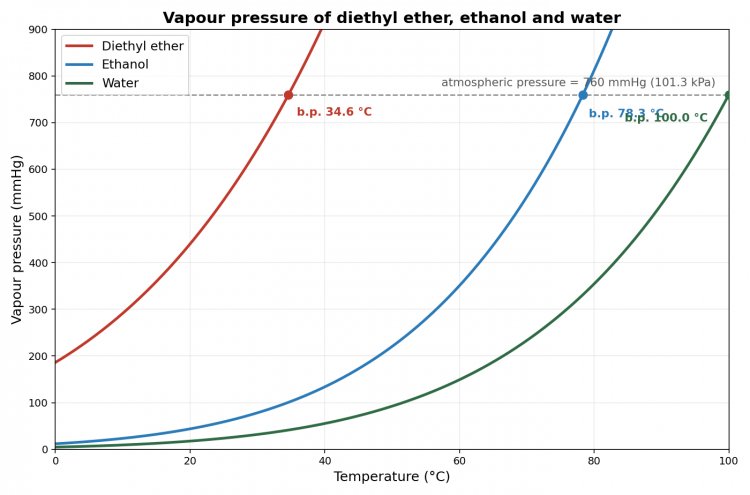
Vapour pressure increases as the intermolecular forces between the liquid molecules decrease. Liquids with weak intermolecular attraction (dispersion forces only) evaporate easily and have high vapour pressure; liquids with strong hydrogen bonding hold their molecules more tightly and have lower vapour pressure. For example, at a given temperature:
Diethyl ether molecules are held together only by weak dispersion forces, so they escape easily and the vapour pressure is high. Water molecules are strongly hydrogen-bonded, so fewer molecules have enough energy to escape, and its vapour pressure is comparatively low. The graph below shows how the vapour pressure of these three liquids rises with temperature, and how each reaches 760 mmHg (1 atmosphere) at its normal boiling point.
3. Presence of Impurities
A non-volatile solute dissolved in the liquid decreases its vapour pressure. Some solute particles occupy positions at the liquid surface, which reduces the surface area actually available for solvent molecules to escape from. Fewer solvent molecules evaporate per unit time, so a new, lower equilibrium vapour pressure is established. This decrease is described quantitatively by Raoult's law and is one of the four colligative properties of solutions.
Surface Tension
Surface tension arises because a molecule inside the bulk liquid is attracted equally in all directions by its neighbours, so the net force on it is zero. A molecule at the surface, however, has liquid molecules only below and beside it and vapour molecules (far fewer, and only weakly attracting) above it. This gives it a net inward pull, which draws surface molecules together and makes the surface behave like a stretched elastic membrane that tends to contract to the smallest possible area — which is why small liquid drops and gas bubbles tend to become spherical.
Effect of Temperature on Surface Tension
Surface tension decreases as temperature increases. When temperature rises, the kinetic energy of the liquid molecules increases, which weakens the net effect of the intermolecular forces of attraction between them. Since surface tension originates from this inward pull on surface molecules, a weaker net attraction means a smaller inward pull, and hence a lower surface tension. Surface tension falls to zero at the liquid's critical temperature, where the distinction between liquid and vapour disappears.
Uses of Surface Tension
- Cleansing action of soaps and detergents: Soap and detergent molecules are surfactants: one end is attracted to water and the other to oil or grease. They lower the surface tension between water and grease, allowing water to spread over and lift away greasy dirt that it would not otherwise wet.
- Action of toothpaste and mouthwash: These products contain surfactants that lower the surface tension of saliva and water, which helps the liquid spread more easily over the teeth and into small crevices, improving contact with the surfaces being cleaned.
Determination of Surface Tension
A. Capillary Rise Method
When a clean, narrow capillary tube is dipped vertically into a liquid that wets glass (such as water), the liquid rises inside the tube to a height greater than the level outside. This happens because the adhesive force between the liquid and the glass wall pulls the liquid up along the tube, creating a curved, concave meniscus. Surface tension acts along this curved surface and is what supports the raised column of liquid against gravity.
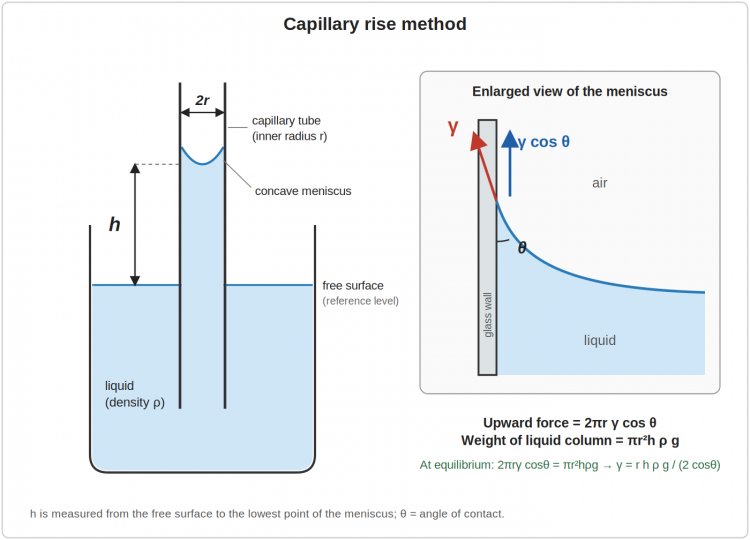
Derivation. Let a capillary tube of internal radius r be dipped into a liquid of density ρ. Let h be the height to which the liquid rises, forming a concave meniscus, and let γ be the surface tension acting along the inner circumference of the tube, at an angle of contact θ to the tube wall.
Upward force due to surface tension = (inner circumference of the tube) × (vertical component of surface tension per unit length)
Downward force = weight of the raised liquid column = mass × acceleration due to gravity = (density × volume) × g
At equilibrium, the upward force balances the downward force:
For liquids such as water in a clean glass capillary, the angle of contact θ is very small and is usually taken as 0°, so cosθ ≈ 1, giving the simplified working formula γ = r h ρ g / 2. Knowing the radius of the capillary, the density of the liquid and the measured height of rise, the surface tension can be calculated directly.
B. Drop Weight Method (Stalagmometer)
This method uses an instrument called a stalagmometer: a graduated pipette with a narrow, flat-tipped capillary at its lower end. As liquid is allowed to flow slowly out of the tip, a drop forms and grows until its weight exceeds the maximum upward force that surface tension can supply, at which point the drop breaks away and falls.
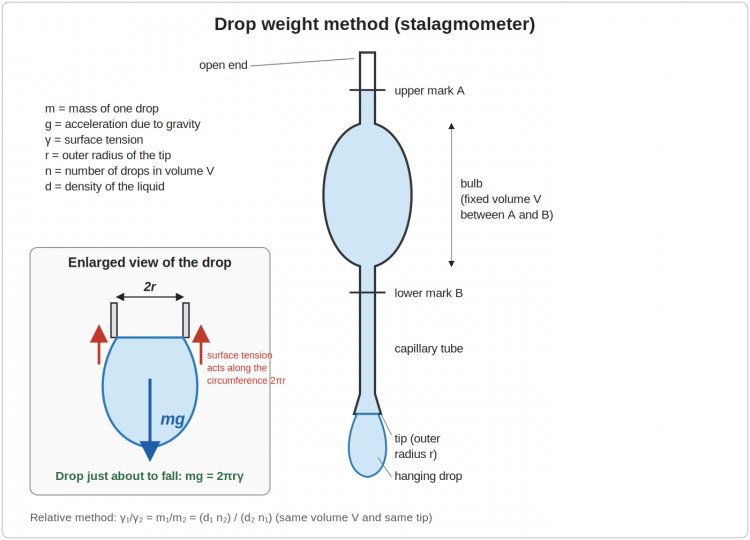
At the instant just before the drop detaches, the upward force due to surface tension acting around the outer circumference of the tip exactly balances the downward pull of gravity on the drop:
where m is the mass of the drop, g is the acceleration due to gravity, r is the outer radius of the capillary tip, and γ is the surface tension.
Procedure. A fixed volume of the liquid, marked on the stalagmometer between an upper mark A and a lower mark B, is allowed to fall drop by drop, and the number of drops, n, formed from this volume is counted. The average mass of one drop, m, is then volume ÷ n, multiplied by the liquid's density. The same measurement is repeated with a reference liquid of known surface tension (usually water) using the same stalagmometer, so that the tip radius r is identical in both cases.
For the unknown liquid (subscript 1) and the reference liquid (subscript 2), each giving n drops from the same volume V:
Dividing equation (1) by equation (2), the unknown tip radius r and g cancel out:
where d1 and d2 are the densities of the two liquids. Since γ2 (the surface tension of the reference liquid, usually water) is already known from standard tables, γ1, the surface tension of the liquid under test, can be calculated.
Viscosity and Coefficient of Viscosity
When a liquid flows, it can be pictured as a series of thin, parallel layers sliding over one another. Because of intermolecular attraction, each layer tends to drag the adjacent, slower-moving layer along with it, while that slower layer in turn resists and retards the faster one. This internal friction between layers is viscosity. Liquids such as glycerine and heavy oils, which have strong intermolecular forces, flow slowly and are described as highly viscous; liquids such as water and alcohol, with weaker intermolecular forces, flow readily and have low viscosity.
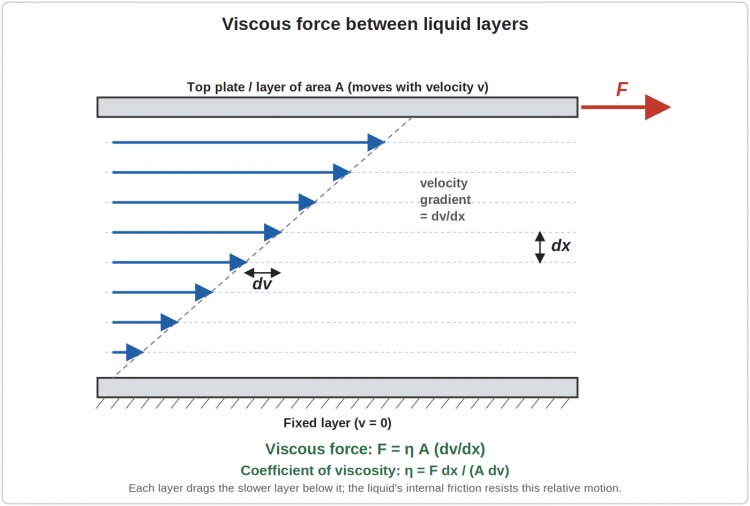
Consider two parallel layers of a liquid, of area A, separated by a small distance dx, moving with a velocity difference dv between them. The viscous force F required to maintain this relative motion is found to be directly proportional to the area of contact and to the velocity gradient (rate of change of velocity with distance) between the layers:
where η (eta) is a constant of proportionality called the coefficient of viscosity of the liquid, dv is the difference in velocity between the two layers, and dx is the distance separating them.
Rearranging, the coefficient of viscosity is given by:
If the area A = 1 cm², the velocity difference dv = 1 cm/s, and the separation dx = 1 cm, then the equation reduces to F = η. This gives the physical definition of the coefficient of viscosity:
In the CGS system the unit of η is the poise (dyn s cm−2); the SI unit is the pascal-second (Pa s), equal to 10 poise.
Determination of Coefficient of Viscosity Using Ostwald's Viscometer
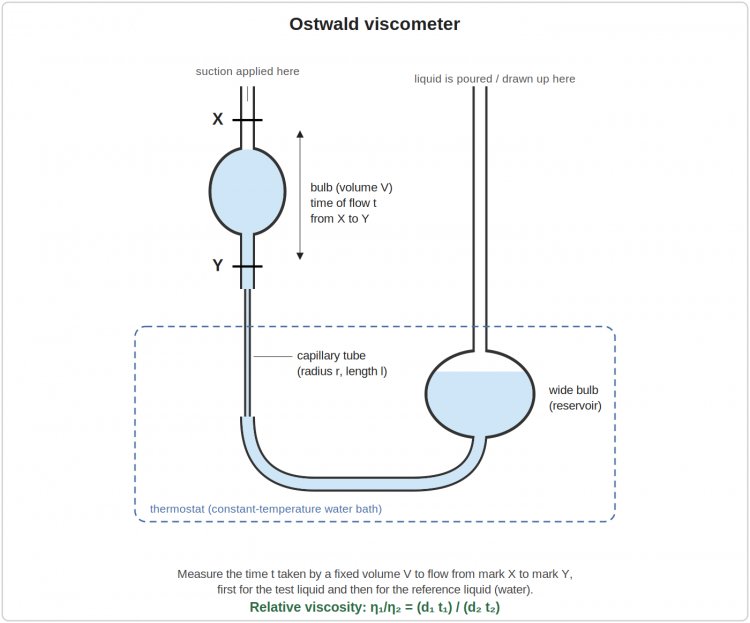
The Ostwald viscometer is based on Poiseuille's law, which relates the volume of liquid flowing through a narrow tube to the properties of the tube and the liquid. According to this law, the volume V of a liquid of coefficient of viscosity η that flows in time t through a capillary tube of radius r and length l, under a pressure difference P, is given by:
Rearranging for the coefficient of viscosity:
Procedure. The test liquid is drawn up into the narrower limb of the viscometer above mark X and allowed to flow down under its own weight through the fine capillary. The time t1 taken for the liquid meniscus to fall from mark X to mark Y — that is, for a fixed volume V to flow through the capillary — is recorded using a stopwatch. The viscometer is then cleaned, and the same volume of a reference liquid of known viscosity (usually water) is timed in exactly the same way, giving a flow time t2. Since the same instrument is used, the radius r, length l and volume V are identical in both measurements; only the driving pressure (which is proportional to the liquid's density, since both liquids flow under their own hydrostatic head) and the flow time differ.
Writing equation (1) for the test liquid (subscript 1) and the reference liquid (subscript 2):
Dividing the first equation by the second, the constant quantities π, r, l and V cancel:
Since the driving pressure at the bottom of a liquid column is directly proportional to the density of the liquid (P = hρg, with the same head height h for both), P1/P2 = d1/d2, so:
where d1 and d2 are the densities of the test and reference liquids. Since the viscosity η2 and density d2 of the reference liquid are known standard values, this equation allows the coefficient of viscosity η1 of the test liquid to be calculated directly from the measured flow times and densities, without needing to know the exact dimensions of the capillary.
Summary Table
| Property | Definition | Effect of temperature | SI unit | Common method(s) of measurement |
|---|---|---|---|---|
| Vapour pressure | Pressure of vapour in dynamic equilibrium with its liquid at a fixed temperature | Increases with temperature | Pascal (Pa) | Static / manometric methods (not detailed above) |
| Surface tension (γ) | Force acting per unit length along the liquid surface, resisting its expansion | Decreases with temperature | N m−1 | Capillary rise method; drop weight method (stalagmometer) |
| Coefficient of viscosity (η) | Force per unit area needed to maintain unit velocity gradient between liquid layers | Decreases with temperature (for liquids) | Pa s | Ostwald viscometer (relative to a reference liquid) |
Important Points for Examination
- Vapour pressure is a dynamic equilibrium property: it increases with temperature and with weaker intermolecular forces, and decreases when a non-volatile solute is added.
- Order of vapour pressure at a given temperature: ether > alcohol > water (weakest to strongest intermolecular forces, reversed).
- Surface tension arises from the net inward pull on surface molecules; it decreases with rising temperature and becomes zero at the critical temperature.
- Capillary rise formula: γ = rhρg / (2cosθ), simplified to γ = rhρg/2 when θ ≈ 0.
- Drop weight formula: mg = 2πrγ at the point a drop detaches; used comparatively as γ1/γ2 = (d1n2)/(d2n1).
- Viscosity is internal friction between liquid layers; F = ηA(dv/dx) defines the coefficient of viscosity η.
- Ostwald viscometer uses Poiseuille's law and gives relative viscosity as η1/η2 = (d1t1)/(d2t2).
- Both the drop weight and Ostwald methods are relative (comparative) methods: they measure the unknown liquid's property against a reference liquid of known value, so the instrument's exact dimensions need not be known.